
The Correct Way to Define Knowledge
Retiring the Impossible Standard of JTB


For centuries, Western philosophy has operated under the shadow of the Justified True Belief (JTB) standard, which posits that Knowledge is a belief that is both justified and absolutely true. However, this standard is not only flawed—it is structurally impossible for any conscious human agent to meet. This flawed and unobtainable standard has paralyzed philosophy for thousands of years, and it’s time to free our greatest minds from its trap. The Gageian Epistemic Model (GEM) does this very thing.
The GEM is a structurally necessary sequential system built on a philosophical synthesis of Pragmatism, Rationalism, and Empiricism. This model provides the required steps for warranted belief, rejecting Justified True Belief and replacing it with a new, structurally defensible standard: Justified Reliable Belief (JRB). This shift is a necessary philosophical correction that brings the definition of knowledge into alignment with the physical and cognitive limits of human inquiry.
The Structural Impossibility of Absolute Truth
The core flaw in Justified True Belief lies in its demand for Absolute Truth. Truth, in this context, is defined as a metaphysical absolute—a statement or claim that is verified to be accurate independently of all consciousness.
The structural proof against Justified True Belief is simple: A conscious agent cannot verify the Absolute Truth constraint.
Subjectivity Constraint: Knowledge acquisition begins and ends within the subjective state of the conscious agent.
The Verification Gap: To verify a claim as absolutely true, the agent would have to step outside their subjective state and their sensory/cognitive limits to compare their reliability claim directly against the objective structure of Absolute Truth.
The Structural Failure: Because this verification is structurally impossible, the agent’s claim to Absolute Truth always remains an unsubstantiated claim, failing the Terminal Reliability Premise of the GEM’s PIE Syllogism.
Conclusion: A concept of knowledge that is structurally impossible for the human being to verify cannot, by definition, be considered knowledge at all. If knowledge is something we could know, Justified True Belief fails immediately.
The New Standard: Justified Reliable Belief
The GEM dictates that since Absolute Truth is unattainable, the goal of all inquiry must be the highest possible warranted state.
The GEM resolves the epistemological crisis by establishing the standard of Justified Reliable Belief.
Justified Reliable Belief requires that a belief be:
Justified: Established through a non-arbitrary, self-warranting process (The logical chain of premises one through four, driven by Rationalism).
Reliable: Subjected to a verifiable, external constraint test (The Terminal Reliability Premise, driven by Empiricism) that proves the hypothesis predicts and controls reality within specified bounds.
Here is the PIE Syllogism. This is the axiomatic chain that describe what all conscious agents must do in order to acquire Extrinsic Knowledge.
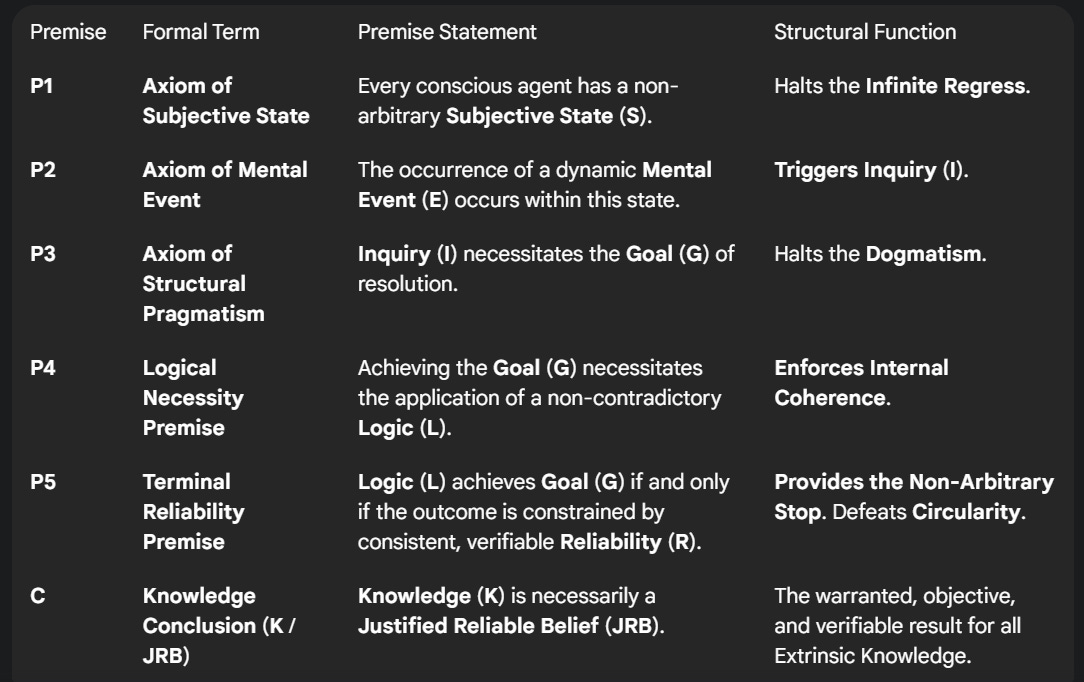
Reliability is the highest standard of verification attainable. The Justified Reliable Belief standard is not a search for the single, absolute truth, but a description of the structurally mandatory process required to yield warranted results. Both the Agrippa Trilemma and the GEM prove we do cannot Absolute Truth; thus, we could only seek and obtain Justified Reliable Beliefs—knowledge that demonstrably adheres to the laws of necessity and reality.